
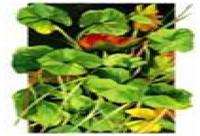
 Former arthritis sufferers are claiming that this common garden plant has taken all their painfful symptoms away.
The herb, Gotu Kola, also known as swamp pennywort, and Indian ginseng, grows in swampy areas from North Queensland to South Western Australia.
Gotu Kola belongs to the botanical family Umbelliferae which also includes Carrots, Parsley ~ Celery, Fennel and Angelica.
The plant has very minute flowers on a 1cm stalk. The fruits of Gotu Kola are flattened discs, 3mm in diameter and occur in upright groups of three “looking like toast in a rack”. It is the leaves however which are the most beneficial.
There are two species which exist in Australia, Centella Asiatica, also called Hydrocotyle Asiatica, and Centella Cordifolia.
Centella Cordifolia has a circular, heart shaped leaf which is toothed around the edge. Centella Asiatica has a more kidney shaped leaf. The leaf sizes can vary from 1cm to 7cm, in more favourable areas. Both the Cordifolia and Asiatica are very similar in their appearance, growing habit, and medicinal value !!
Growing Needs
Preferring a semi-shade position in moist, fertile soil, Gotu Kola can be grown successfully in garden beds, tubs and patio hanging baskets.
In order to be able to harvest two leaves a day, it will be necessary to allow at least a month for the plant to establish itself.
To ensure a bountiful supply, a weekly feed with a liquid fertilizer such as phostrogen, is recommended. Snails are found to have a passion for Gotu Kola so it will be necessary to apply snail pellets, or to generously spread· sawdust around the plant.
Using Gotu Kola
The recommended dosage is two leaves a day, these can be eaten whole or added to stirfry dishes, rice and salads. An infusion of the leaf can be beneficial as a wash on burns and wounds.
Consumers have claimed that within three months of eating two leaves a day, arthritis has been cured.
It is not advisable for people suffering from cardiovascular disorders, peptide ulcers or hypertension to take Gotu Kola, nor is it advisable for anyone to exceed more than two leaves a day, as severe headaches and dizziness will result.
Biochemical analysis has found its active constituents to include asiaticoside, thunkinside, madecassic acid, and brahmoside.
It has been found to have anti-bacterial activity; anti-fungal; anit-amaebic; anti-ulcer effects on gastric and duodenal ulcers; anti-inflammatory effects externally; mild sedative effects; and anti-spasmodic effects.
Beneficial effects have been found in the treatment of wounds, burns and ulcers, using an infusion of Gotu Kola leaves, Results of this treatment have been accelerated tissue regeneration and reduced scarring.
Gotu Kola has been used medically in Asia for thousands of years for fever; rheumatism; gastric complaints; leprosy; ageing; nervous breakdown; depression; and longevity.
Is it any wonder it’s called “the elixir of life” in eastern countries.
